Bone Density Scores Explained: T-Score vs. Z-Score and What They Mean for Your Skeleton
The T-score compares your bone density to a young, healthy adult at peak bone mass and is used to diagnose osteoporosis. The Z-score compares you to people your own age and is used to flag unusual bone diseases. Women past menopause and men over 50 should focus on the T-score: anything below -2.5 signals osteoporosis and elevated fracture risk. Younger individuals should look at the Z-score: a value that's too low means your bones are significantly worse than your peers', suggesting another underlying condition.
Yue-Gui is sixty years old and has just retired from her position as an elementary school principal. The first thing she did in retirement was sign up for a hiking club, determined to conquer the mountain peaks she'd been too busy to visit.
Before setting out, she was cautious enough to get a full health checkup. Most of her numbers were within normal range, but the bone density section made her pause: lumbar spine T-score -2.3, hip T-score -1.8.
"Negative numbers?" She stared at the red-flagged values, her first reaction being that something must be wrong with the test. She walks to and from work every day and hikes on weekends. How could her bones be in trouble?
Back home, she looked it up and discovered that a T-score below -2.5 qualifies as osteoporosis. Her lumbar spine at -2.3 hadn't crossed that line, but she was standing right at the edge of the cliff. Then she thought about Mrs. Zhang from the neighborhood — Mrs. Zhang had simply slipped in the bathroom and fractured her wrist. Six weeks in a cast, and she still can't wring out a towel.
"What if I fall on a mountain trail?" The thought made her hesitate about keeping her hiking club registration.
Seeing a negative number flagged in red on your report would make anyone nervous. But this "negative" is not the same as an overdrawn bank account. It's actually the result of a comparison. Once you understand what T-scores and Z-scores mean, you'll be able to hear what your body is telling you.
Why the Report Shows a Red Flag
Many people can't make sense of the report because they don't understand how these two scores are calculated. Put simply, they show where you rank in the "bone density competition."
Two everyday analogies will make this clear.
Analogy 1: Competing Against Olympic Athletes (T-Score)
Imagine you're sixty years old. To assess your fitness, we take your current performance and pit it against people aged 25 to 45 — those in their absolute physical prime.
That sounds pretty unfair, doesn't it?
That's exactly what the T-score does. It compares your bone mineral density against a young, healthy reference group (typically ages 25 to 45).
As we age, physical capacity (and bone mass) naturally declines. So compared to your youthful peak, a negative score is perfectly normal. The negative number tells you how much bone you've lost relative to your strongest years.
If the loss is excessive and exceeds the safety margin, bones become brittle. That's what we call osteoporosis.
Analogy 2: Comparing Heights with Your Classmates (Z-Score)
Now imagine a different scenario. You're thirty years old, and instead of competing against Olympic athletes, we place you in a group of people the same age and sex.
That's the Z-score. It compares you with your "classmates."
If your bone density is at the average for your age group (a score of 0), that's great. But if your score is very low (say, below -2.0), it means that among people who are all the same age, your bones are notably worse.
At this point, we wouldn't just chalk it up to aging, because everyone in the group is the same age. If your bones are worse than theirs, there must be another reason — perhaps malnutrition, an endocrine disorder, or a medication affecting your bones.
What Does the Research Say?
The medical community draws a very clear line between when to use each score. Using the wrong benchmark can send treatment in a completely wrong direction.
T-Score: Fracture Risk Indicator for Older Adults
According to the World Health Organization (WHO), the T-score is expressed in standard deviations (SD). It is the primary basis for diagnosing osteoporosis, particularly for postmenopausal women and men over 50.
Here's how to read it:
Normal: T-score at or above -1.0. Your bones have lost a tiny bit compared to a young person's, but you're still well within the passing range.
Osteopenia (low bone mass): T-score between -1.0 and -2.5. Think of a fuel gauge dropping below half. The car still runs, but it's reminding you to pay attention to maintenance.
Osteoporosis: T-score at or below -2.5. At this point, bone structure has become porous, like a building made with substandard concrete. Structural support is compromised, and fracture risk increases substantially.
So when a patient sees a T-score of -2.8, they have indeed met the definition of osteoporosis. This doesn't mean the bone will snap tomorrow, but it means the foundation is unstable and reinforcement work needs to begin.
This is also the key basis for doctors deciding whether to prescribe osteoporosis medication and assessing fracture risk.
Z-Score: The Warning Signal for Young People
When is the Z-score used? The International Society for Clinical Densitometry (ISCD) recommends that for premenopausal women, men under 50, and children, the T-score should not be used. The Z-score should be used instead.
Why? Because young people shouldn't be losing bone mass.
If a thirty-year-old has a Z-score below -2.0, the medical report will state "below expected range for age." That sets off alarms: this isn't straightforward.
It may indicate that an underlying disease is silently eroding bone — a condition called secondary osteoporosis. The doctor will start investigating causes. Could it be a parathyroid problem? Long-term corticosteroid use? A gastrointestinal malabsorption disorder?
The priority at this point isn't rushing to take bone-building medication. It's catching the real culprit.
Why Is an Older Person's T-Score Always Lower Than Their Z-Score?
This is an interesting phenomenon. If you look closely at a seventy-year-old's report, the T-score will typically be lower than the Z-score, and the gap widens with advancing age.
The reason is simple. The T-score compares against young adults, so the gap is naturally large. The Z-score compares against peers, and since everyone has declined together, you may rank fairly well among your age group (normal Z-score) even though your bones are actually quite fragile (very low T-score).
This is why older adults must never rely on the Z-score alone. If you only look at the Z-score, you might think, "I'm about the same as my neighbor Old Wang," and ignore the fact that both of you are in a high fracture risk zone.
Pitfalls Behind the Numbers
There are a few traps to watch for when interpreting reports. DXA scans are precise but can occasionally be fooled.
If your spine has bone spurs (osteophytes) or severe degenerative arthritis, those areas appear dense and white on the scan. The machine may mistake these for healthy bone, producing a falsely elevated reading.
This is why a single number is never enough. Doctors also need to integrate imaging, clinical history, and a check for other confounding factors.
Do I Need Further Action?
Don't panic. Start by matching yourself to this table.
- Postmenopausal women and men over 50, T-score at or above -1.0: Normal. Maintain your current habits with balanced diet and regular exercise.
- T-score between -1.0 and -2.5: Osteopenia (low bone mass). Warning sign. Increase calcium and vitamin D intake, do weight-bearing exercises, and schedule regular follow-ups.
- T-score at or below -2.5: Osteoporosis. High risk. See an orthopedist or family medicine doctor. Medication may be needed. Focus on fall prevention.
- Premenopausal women, men under 50, and children, Z-score above -2.0: Within expected range. Bone density is comparable to peers. Keep up the healthy lifestyle.
- Z-score at or below -2.0: Below expected range. Abnormal. Possible underlying disease. Seek medical evaluation for endocrine or nutritional absorption issues.
Are There Side Effects or Risks?
Is the test itself safe? This is a common question before the scan.
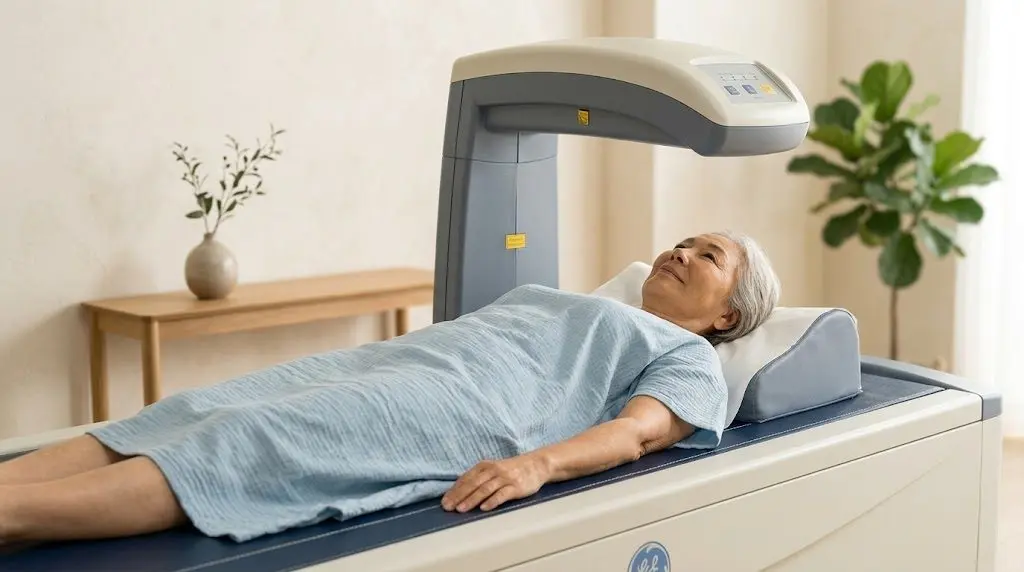
The radiation dose from a DXA scan is very low — about one-tenth of a chest X-ray, or even less. A single scan delivers roughly the same radiation as a few days of normal background exposure from daily life. There's no reason to refuse the test out of fear of radiation.
However, as mentioned, there is a risk of false negatives. If your spine is loaded with bone spurs or your blood vessels are calcified, the machine counts that extra calcium as bone density. The result is that even though the bone interior may be hollowed out (osteoporosis), the report shows a deceptively reassuring score.
This is why doctors sometimes scrutinize the results carefully, even excluding a few abnormally dense vertebrae from the calculation to get at the truth. If you've had spinal surgery with hardware (screws, rods), be sure to inform the technician before the scan, as this will affect accuracy.
What Does the Doctor Recommend?
Once you understand the numbers, the real question is: what comes next? Whether your T-score is -1.5 or -3.0, there are fundamentals you can start on right now.
Eat Right to Build Bone Reserves
Bones need raw materials. The two most basic are calcium and vitamin D.
Calcium isn't only found in milk. Black sesame seeds, small dried fish, and dark green leafy vegetables (like kale and amaranth) are excellent sources. If you're lactose intolerant, yogurt and cheese are good alternatives.
Vitamin D acts as the delivery driver, ferrying calcium from the intestine into the bloodstream. Sunlight is the best source. Try exposing your arms for ten to fifteen minutes a day. If you're concerned about sun damage or rarely go outdoors, a vitamin D supplement is an efficient alternative.
Give Your Bones Some Stress
Bones are unique: the more you load them, the harder they grow. That's why swimming, while excellent for cardiovascular fitness, does relatively little for bone density — water's buoyancy reduces the force on bones.
The best exercises for bones are weight-bearing activities: brisk walking, jogging, climbing stairs, or moderate resistance training. Every time your foot strikes the ground, the impact stimulates bone cells to work. For elderly individuals who may find vigorous exercise unsafe, simple squats and tai chi can also be effective while improving balance and reducing fall risk.
When to Follow Up
If you have osteopenia (T-score between -1.0 and -2.5), follow up with a DXA scan every one to two years to monitor the rate of bone loss.
If you already have osteoporosis (T-score below -2.5) or have had a fracture, stick with your doctor's treatment plan. Many medications are available today that can either lock in existing bone or stimulate new bone growth. These aren't quick fixes. Long-term commitment is usually required. Never stop your medication on your own.
Common Misconceptions
Myth 1: A negative T-score means I'm sick, right?
The truth: Not necessarily. A negative T-score simply means your bone density is lower than a thirty-year-old's. This is extremely common in people over 50. It's like losing a 100-meter sprint to a younger person — it doesn't mean you're diseased, but it does mean your body is aging and needs maintenance. The key is not to let it drop past -2.5.
Myth 2: Can young people use the T-score to diagnose osteoporosis?
The truth: No. Young people's bones are still in a metabolically active phase, so using the T-score could lead to misdiagnosis. Young people should use the Z-score. If a young person's Z-score is very low, we wouldn't call it "osteoporosis." We'd say the bone density is "below expected for age" and then investigate the underlying cause.
Myth 3: Can calcium supplements rebuild bone?
The truth: Calcium supplements alone are usually not enough. Once bone loss has reached the osteoporosis threshold (T-score below -2.5), relying solely on calcium is like painting the walls of a house whose beams are about to snap. At that point, medication is typically needed, in combination with calcium, vitamin D, and exercise, to effectively reduce fracture risk.
Conclusion
After hearing the explanation, Yue-Gui's furrowed brow finally relaxed. She understood that -2.8 was a warning, but not the end of the world. This report was like a registered letter from her own body, reminding her it was time to take bone health seriously.
Now pick up your health report. Are you someone who needs to look at the T-score, or the Z-score? If the numbers are in the safe range, congratulations, keep it up. If the light has turned red, don't be afraid. Bring the report to your family medicine doctor or orthopedist for a discussion.
Want to know how high your fracture risk really is? Next time, we'll talk about how to use your T-score plus a simple questionnaire to calculate your ten-year fracture probability.
Key Takeaways
T-score compares you to young adults: For those over 50 or postmenopausal women, a T-score below -2.5 means osteoporosis.
Z-score compares you to your peers: Younger people should use the Z-score. A value below -2.0 means your bones are significantly weaker than your age group, and the underlying cause must be found.
Older adults should not rely on the Z-score alone: Your peers may all be fragile too. A normal Z-score with a very low T-score still places you in the high-risk category.