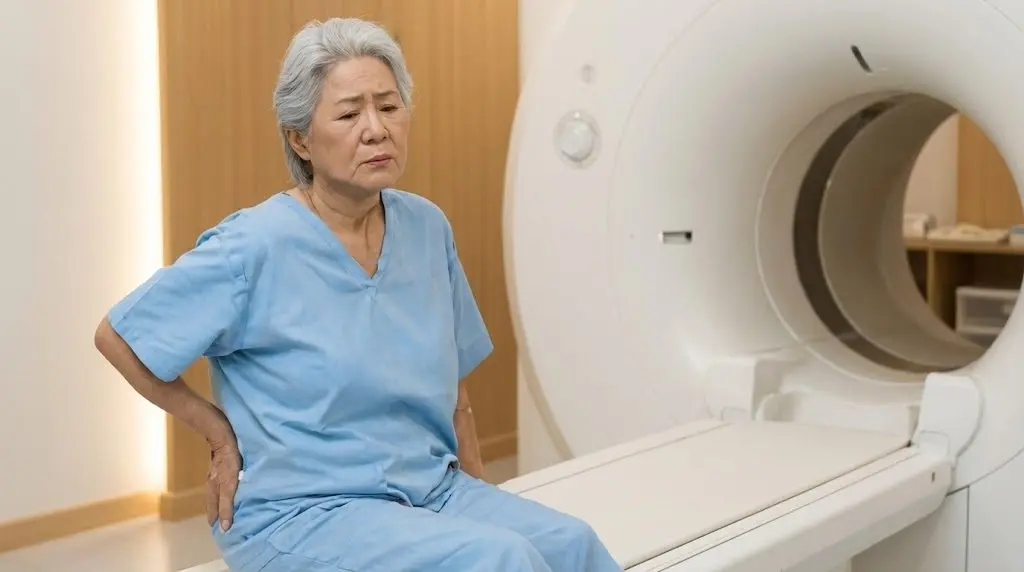
Don't Rush to Get an MRI for Back Pain — Unless You Have These 6 Red Flag Symptoms
Low back pain is a modern epidemic, but the vast majority of cases do not require an MRI.
According to authoritative medical journals, premature advanced imaging not only fails to help treatment but may actually cause harm by uncovering age-related changes that have nothing to do with the pain, leading to unnecessary anxiety and overtreatment. Unless you have red flag symptoms such as leg weakness, fever, or a history of cancer, conservative treatment is the safest first step.
Zhen-Yu is thirty-eight and works as a warehouse supervisor at a logistics company. His daily routine involves overseeing shipments and occasionally helping move heavier boxes. Last Friday before clocking out, he bent down to lift a case of bottled water off a pallet when his back suddenly went "pop," and an electric-shock-like pain shot up from his lower back.
He crouched on the ground for a long while before managing to stand. That evening at home, he lay down and stuck on two pain relief patches. He barely moved all weekend, and the pain gradually shifted from sharp to a dull ache. His wife booked a Monday appointment.
Before the visit, he did what many people do — searched "causes of back pain" online. The first few pages of results mentioned bone spurs, herniated discs, spondylolisthesis, and even tumors. The more he read, the more alarmed he became. His very first words in the exam room were: "Doctor, can I just get an MRI? I want to make sure there's nothing serious going on in there."
This request is extremely common in clinic. But if you ask the doctor, you'll get an answer that may feel counterintuitive: for most people with back pain, getting an MRI too early is actually not the best choice.
Why the Report Shows a Red Flag
When a doctor declines your request for an MRI, it's not because your pain isn't real, and it's not because we don't care. There are two secrets about how the body works that, if left unspoken, may leave you perpetually uneasy.
The Body's "Gray Hair"
Imagine we went to a random street and photographed the tops of a hundred fifty-year-olds' heads. Many would have gray hair.
Now, if one of them happened to have a headache, and we pointed at the photo and said, "See? You have gray hair. That's what's causing your headache," would you believe it?
You'd think that was absurd, because people without headaches also have gray hair.
The spine works the same way.
After years of use, the spine naturally develops some wear and tear — a slightly bulging disc here, a bone spur there. These are the body's internal equivalent of gray hair: marks of time.
Many people with absolutely no back pain, if you put them in an MRI machine, would have reports documenting "disc herniation" or "bone spurs." If your pain is simply a muscle strain, but the MRI shows a bone spur, and you mistakenly blame the spur, you end up chasing the wrong treatment — or even going under the knife for nothing.
Seeing "Traffic" Doesn't Mean Seeing the "Accident"
Imagine looking at Google Maps' live traffic view. The road shows red, meaning it's congested (that's your pain).
You pull up the satellite image (that's the MRI) and spot a car that's been broken down on the roadside for ages.
Your instinct says: "That's the car causing the traffic jam." So you spend a fortune towing it away.
Result? The congestion hasn't improved at all. Why?
Because the real cause was a malfunctioning traffic light up ahead, or simply too many cars — nothing to do with that old car parked on the shoulder for ten years.
An MRI can show the spine's structure very clearly (the old car), but it can't show the functional causes of pain (the broken traffic light).
Much of the time, your back pain is caused by muscle tension, poor posture, or a weak core. These are things an MRI simply cannot capture. If you rely too heavily on imaging, you'll overlook the rehabilitation and exercise that actually need to happen, and the pain drags on even longer.
What Does the Research Say?
Whether back pain truly requires an MRI has been debated in medicine for years. The good news: we now have very clear answers, drawn from the consensus of authoritative journals and major clinical guidelines.
Acute Back Pain: The First Six Weeks Are the Key Observation Period
If your back pain just started (called acute back pain) and has lasted less than six weeks, the American College of Occupational and Environmental Medicine (ACOEM) is blunt: don't get an MRI.
Why so definitive?
Because the vast majority of acute back pain, whether or not you get imaging, will gradually resolve on its own within six weeks. During this window, the body has powerful self-healing capabilities.
Unless your symptoms are unusual. "Unusual" means progressive neurological deficits — in plain language, your leg is getting weaker day by day, or the numbness is spreading and worsening.
Or the doctor suspects cauda equina syndrome (which affects bladder and bowel control), a history of cancer, persistent fever with elevated inflammatory markers, or a pain pattern that's very atypical (such as involvement of multiple nerve roots).
If none of these alarming scenarios apply and your pain is straightforward, an MRI during the first six weeks offers zero benefit. It only costs time and money.
Chronic Back Pain: When to Consider Imaging
If the pain has persisted beyond six weeks, becoming subacute or chronic, should you get one then?
Not necessarily.
According to the guidelines, MRI is only "moderately recommended" in the following scenario: your sciatica (that pain radiating from the buttock down the leg) has lasted more than four to six weeks, you've already tried medication and physical therapy, symptoms haven't improved at all, and you're now considering surgery.
In that situation, the doctor needs a map for surgical planning, and that's when an MRI has value. The prerequisite is that the imaging findings must correlate with your clinical symptoms.
Additionally, if your pain is severe enough that the doctor is considering an epidural steroid injection (a pain treatment), then arranging an MRI after three to four weeks of pain is reasonable, because the doctor needs to confirm the injection site.
The "Disconnect" Between Imaging and Pain
This is the most commonly misunderstood point, and the reason top-tier journals like The New England Journal of Medicine and The Lancet oppose routine imaging.
Research has found that MRI findings and the pain patients actually feel are poorly correlated.
In plain terms: some people are in terrible pain, but the MRI looks clean; others are bouncing around with no pain at all, but the MRI is full of bone spurs and disc herniations.
This is the phenomenon of "high rates of asymptomatic abnormalities."
Because the risk of "seeing a shadow and pulling the trigger" is so high, multiple clinical guidelines advise: if you have ordinary, nonspecific back pain (pain with no identifiable serious cause), save the MRI. Unless you have red flag symptoms, or after a period of conservative treatment (medication, physical therapy), the pain stubbornly refuses to leave.
What Exactly Are Red Flag Symptoms?
We've been mentioning "red flags" throughout. What are they, exactly?
Simply put, they're distress signals from the body indicating a potentially serious underlying condition — infection, malignancy, or cauda equina syndrome.
When these signals appear, the MRI's role is to rule out these serious diseases, or to guide management when neurological symptoms are progressively worsening.
In summary, an MRI is a powerful sword. Used in the right situation (ruling out serious disease, planning surgery), it can save lives. Used in the wrong situation (ordinary back pain), it only creates confusion.
Do I Need Further Action?
Here's a quick reference table to help you assess your situation. But remember, this is for guidance only. Your actual condition should always be evaluated by a doctor in person.
- Just tweaked your back, simple pain: Conservative treatment (gentle activity, heat, pain relievers). For those with less than six weeks of pain, no leg numbness, no weakness. Observe for four to six weeks; it usually improves.
- Back pain with red flag symptoms: Seek medical evaluation promptly (MRI may be needed). For those with a cancer history, fever, unexplained weight loss, loss of bladder/bowel control, or leg weakness. Arrange immediately.
- Long-standing sciatica: Evaluate for further workup (consider MRI). For those with pain lasting over four to six weeks, unresponsive to rehab and medication, severe enough to consider surgery. When symptoms persist without improvement.
- Considering an injection for pain relief: Discuss with your doctor (MRI may be needed for localization). For those considering an epidural steroid injection. After three to four weeks of pain.
Are There Side Effects or Risks?
At this point you might ask: "It doesn't hurt to get scanned, and MRI doesn't have radiation. Why is the doctor so against it? Are there really side effects?"
Indeed, MRI doesn't carry the radiation risk of X-rays or CT scans. Physically, it's very safe. But it has psychological and decision-making side effects that are often overlooked.
First: the labeling effect.
When you see words like "degeneration," "herniation," and "stenosis" on the report, it's as if you've been slapped with a label that says "you are a patient." Numerous studies show that people who learn about their spinal degeneration become afraid to exercise, afraid to bend over. Psychological stress increases, which actually amplifies the sensation of pain and slows recovery. You might have been fine in two weeks, but after seeing the report, fear keeps you hurting for two months.
Second: overdiagnosis and overtreatment.
Because MRI is so sensitive, it picks up many small issues that don't need to be addressed. If you and your doctor decide to operate based on "abnormalities" that have nothing to do with the pain, you're taking on surgical risks (anesthesia, infection, nerve damage) that may not result in any pain relief. It's like getting plastic surgery because of a pimple on your face — the cost is wildly disproportionate to the benefit.
Additionally, MRI carries a false positive problem. As noted, it may show structural abnormalities that are not the source of your pain. This can misdirect treatment and lead you on a wild goose chase.
What Does the Doctor Recommend?
Since an immediate MRI isn't recommended, what should you do when you're in serious pain? Just grit your teeth and bear it? Of course not.
Stay Active — Don't Just Lie in Bed
The old belief was "bed rest for back pain." That's completely wrong. Modern medicine has established that moderate activity actually speeds recovery.
Don't spend all day in bed. That causes back muscles to atrophy and makes the spine even less stable. Within your pain tolerance, maintain normal daily activities. Walking is an excellent option.
If the pain is severe, rest for a day or two at most. Don't exceed two days.
Medication and Physical Therapy Are Good Allies
At this stage, anti-inflammatory painkillers, muscle relaxants prescribed by your doctor, or the stretching exercises taught by a physical therapist are all designed to get you through the acute phase. These treatments ease symptoms and allow the body's natural repair mechanisms to kick in.
Give the body time. Most tissue injuries need a few weeks to heal.
When Should You Be Concerned?
Although I'm telling you to take it easy, vigilance is still important. If you notice any of the following during the observation period, come back to the clinic immediately. At that point, we won't hold you back — we'll arrange the necessary tests:
Pain that keeps escalating, completely unresponsive to medication.
Leg weakness that's getting worse — frequent tripping or inability to keep slippers on.
Difficulty with urination or bowel movements, or numbness in the "saddle area" (the region that would contact a bicycle seat).
Pain that wakes you at night, or pain that's worse at rest than with activity.
Fever with no other identifiable cause like a cold.
Common Misconceptions
Myth 1: Isn't a more expensive test better at finding the cause?
The truth: Not necessarily. For back pain, a thorough medical history and physical examination (the doctor feeling, tapping, and testing your nerve responses by hand) often provide a more accurate assessment of severity than an MRI. An MRI can only see structure. The doctor's hands and brain assess function.
Myth 2: I need an MRI before I can have surgery, so I should get one now.
The truth: You've got the sequence backwards. We order the MRI after we've decided surgery is needed, to confirm the surgical approach. We don't order the MRI to decide whether surgery is needed. If your symptoms don't yet warrant surgery, an MRI has no impact on your current treatment plan.
Myth 3: Finding it early means treating it early!
The truth: For back pain, early MRI frequently leads to misguided treatment. As discussed, seeing an asymptomatic bone spur and rushing to surgery can actually leave you worse off after the operation. True "early treatment" means starting to fix your posture early, starting to exercise early, and quitting smoking early (smoking makes back pain harder to resolve).
Conclusion
The body has powerful self-healing capabilities. Give it time, cooperate with your doctor's conservative treatment, and the vast majority of pain will fade away. That sophisticated MRI machine — save it for those who truly need it, or wait until you genuinely develop red flag symptoms.
If you're currently suffering from back pain, take an honest look at your lifestyle habits. Stay moderately active and closely monitor your symptoms. If you have concerns, find a doctor you trust and let their expertise guide you, rather than letting a cold imaging report frighten you.