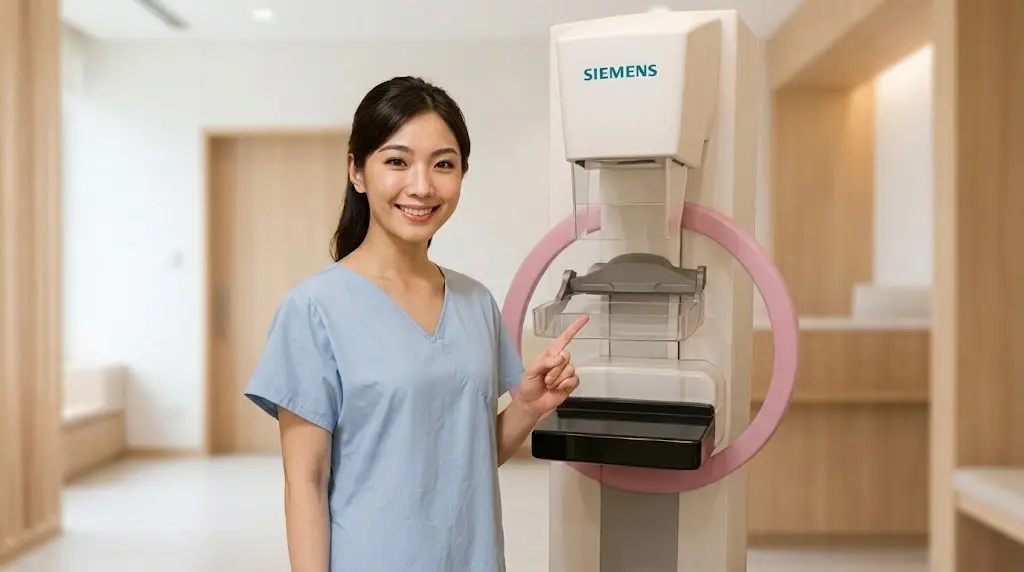
Afraid of Mammograms After Breast Augmentation? 4 Screening Essentials to Protect Both Your Implants and Your Health
Women who have had breast augmentation still need to follow standard mammography screening recommendations. The key is using the "implant displacement" (Eklund views) technique, which pulls breast tissue forward and pushes the implant back, dramatically improving image clarity and uncovering hidden lesions. If implant rupture is suspected, MRI is the go-to tool; ultrasound is useful for evaluating palpable lumps but cannot fully replace mammography.
Hsiao-Wei was forty-two and ran a small online clothing boutique. She had breast augmentation eight years ago, recovered smoothly, and had not had any issues since. But every October during Breast Cancer Awareness Month, the flood of screening reminders on social media cast a shadow over her heart.
It was not that she had never considered getting a mammogram. The problem was that every time she searched "breast implants mammogram," the forum posts made her retreat: some said the implant would get crushed, others said the images would be useless so why waste money, and still others shared stories of implants shifting afterward.
Three years passed while she kept avoiding it.
Then last month her best friend was diagnosed with stage-zero breast cancer. She had timely surgery and recovered well. Her friend told her: "Thank goodness I went. If I had waited another six months, it wouldn't have been stage zero anymore." That sentence haunted Hsiao-Wei.
She finally mustered the courage to schedule the exam, but after booking she grew anxious again. She texted her friend: "Do you have implants? If not, it's a different situation..." Her friend did not, so she could not answer the question.
How should someone with implants approach screening? Will the machine really destroy the implant? These questions already have clear answers in medicine. Today we will put all these worries to rest, so that anyone sharing the same concerns can walk into the exam room with confidence.
Why This Exam Feels So Conflicting
To explain what happens during a mammogram with implants -- and how doctors overcome the challenges -- let us use two relatable examples.
Like Photographing a Landscape Blocked by a Pillar
Imagine trying to take a scenic photo, but a massive white pillar (your implant) stands right in front of the view. If you just snap the shutter as usual, all the flowers and trees behind it (breast tissue) are completely hidden.
This is the biggest challenge traditional mammography faces with augmented breasts. The implant is radiopaque -- or rather, extremely dense -- making it difficult for X-rays to see through to the tissue behind it. Without adjustments, the physician reviewing the images finds a large blind spot, and anything growing in that spot could be missed.
Push the Pillar Aside and the View Appears
Since the pillar is in the way, we need to move it. That is the medical technique known as "implant displacement" (Eklund views).
During the exam, the radiologic technologist uses a specialized maneuver to push the "pillar" (implant) backward against the chest wall while gently pulling the "scenery" (native breast tissue) forward, then compresses only that tissue for imaging.
This way, tissue previously hidden behind the implant is fully exposed. Although it might sound painful or scary, this is a standard procedure performed by specially trained technologists. It significantly increases the visible area, and the image is free from interference by the bright-white implant, allowing the physician to read it much more accurately.
What Does the Research Say?
Many women still worry: "Is all that pushing and pulling really safe?" or "Is it truly necessary?" Let us see what the medical evidence says.
Specialized Views Are Standard Protocol
According to current medical consensus, mammography screening for women with implants should include two sets of views: the standard projections and the implant displacement views (Eklund views).
Research shows that when the technologist performs this push-back, pull-forward maneuver, it significantly improves breast tissue visibility -- like pulling open curtains to let sunlight flood a dim room. For early breast cancer detection, this step is absolutely non-negotiable. It helps physicians detect cancer signs far more effectively.
So when you notice the technologist spending extra time adjusting your positioning, or the pulling sensation feels a bit more pronounced, do not worry. It means she is performing the most thorough, standardized examination protocol for you.
Accuracy Is Affected, So Careful Technique Matters Even More
We must be honest: with implants in place, mammography sensitivity is indeed slightly lower than in women without implants.
It is like feeling objects through gloves -- the tactile feedback is inevitably less sensitive. In particular, if capsular contracture has formed (the body grows a thick membrane around the implant), or if the implant sits below the breast gland rather than below the muscle, imaging becomes even harder.
Research data confirm that implants do reduce sensitivity. But the good news is that adding the implant displacement step compensates for this inherent limitation, minimizing the risk of missed findings due to implant obstruction. That is why we always emphasize: you must inform the technologist that you have implants so they can use the right technique to bridge this gap.
Screening Frequency Is the Same for Everyone
Many augmented women ask: "Should I get screened more often?" or "Can I do it less frequently?"
The U.S. Preventive Services Task Force (USPSTF) and the American Cancer Society are clear: your screening age and frequency are exactly the same as for women without implants. There is no need to increase screening because of implants, but you absolutely must not reduce it because it seems inconvenient.
When it is time, go. Whether it is government-subsidized screening or a self-pay health exam, the rules are universal. Breast augmentation itself does not increase your cancer risk, but it does increase the difficulty of detection. That is why we need more precise technique -- not more frequent or less frequent screening.
The Roles of MRI and Ultrasound
Besides mammography, you have probably heard of MRI and ultrasound. In augmented women, each serves a different purpose.
If there is concern about implant rupture, leakage, or capsular contracture complications, MRI is the most effective tool. The American College of Radiology recommends MRI for evaluating implant integrity, as it can clearly differentiate silicone from native tissue. If infection or malignancy is a concern, contrast-enhanced MRI also assists in evaluation.
Ultrasound is typically a supportive tool. If you feel a lump yourself, or if the mammogram shows something ambiguous, the physician uses ultrasound for further clarification. But remember: ultrasound cannot replace mammography for routine screening, because certain early calcifications -- important markers for early breast cancer -- are invisible on ultrasound.
Do I Need Further Action?
To clarify when to use which test, here is a reference table:
Routine health screening: Schedule the exam and proactively inform the facility you have implants. Mammography with standard plus implant displacement views. Follow screening age guidelines (e.g., every 2 years).
Palpable unknown lump: See a doctor immediately for assessment. Mammography plus ultrasound. Immediate action.
Indeterminate mammography result: Follow doctor's advice for further evaluation. Primarily ultrasound; MRI if needed. Follow-up per physician instructions.
Suspected implant rupture or leakage: Evaluate implant structural integrity. Breast MRI. Immediate action.
Hardening around the implant (capsular contracture): Assess severity and complications. MRI or ultrasound. Depends on severity.
Are There Side Effects or Risks?
When it comes to medical exams, the top concern is safety. With all the pushing and compressing, will anything go wrong?
First, the fear everyone has: implant rupture. Under standard mammography technique, the probability of causing implant rupture is extremely low. Today's technologists are professionally trained, especially for augmented patients -- they know how to modulate pressure and how to avoid directly compressing the implant body. Although the theoretical risk is not zero, cases of implant rupture caused by mammography are exceedingly rare in clinical practice.
However, discomfort during the exam may be more noticeable than for other women. Pushing the implant back and pulling the skin and tissue forward inevitably creates a sensation of tightness and tugging. Those with tight skin or recent surgery may find it more uncomfortable. But this sensation typically fades quickly after the exam and leaves no lasting effects.
Additionally, mammography uses X-rays, which means a small dose of radiation. This risk is the same for all women and is not increased by having implants. The medical community agrees that the minuscule cancer risk from this radiation is far outweighed by the benefit of detecting early-stage cancer.
One more thing to prepare for mentally: the possibility of a false positive. Because of implant interference, shadows on the image may look problematic but turn out to be overlap artifacts or implant folds. This could lead to additional ultrasound or biopsy and a few days of worry. But for the sake of confirming your health, such caution is a necessary process.
What Does Your Doctor Recommend?
Now that you know the exam is safe and necessary, how should you plan your health strategy as a woman with implants?
Speak Up When You Book
This is the most important step. Do not be shy, and do not wait until you are already in the exam room. When calling to schedule or filling out the intake form, clearly note: "I have had breast augmentation surgery."
If registering in person, remind the nurse at check-in. This way, the technologist can prepare equipment and settings in advance and allocate extra time, since the implant displacement technique takes longer than a standard exam.
Choose the Right Time
Just like any woman, avoid scheduling during the week before your period. Breasts are usually more swollen and tender then, and undergoing compression at that time only makes the experience more painful and may hinder the technologist's workflow. Going about a week after your period ends, when breasts are at their softest, is the smarter choice.
Self-Examination Matters
Although technology is powerful, the person who knows your body best is you. During showers, take a moment to feel around: Has the implant shape changed? Is one side suddenly harder? Can you feel a lump that was not there before?
For women with implants, implant deformation or displacement could signal capsular contracture or implant rupture. If anything seems off, do not wait for the annual screening -- schedule an appointment right away.
Do Not Let Fear of Discomfort Keep You Away
I have had patients say: "Doctor, can I just do ultrasound instead? I don't want to be compressed."
I would love to let you off easy, but from a medical standpoint, I must say no. As mentioned, ultrasound and mammography detect different things. Calcifications are a critical early indicator of breast cancer, and they are a blind spot for ultrasound.
To keep your health safety net intact, these two modalities cannot substitute for each other.
Clearing Up Common Misconceptions
Myth 1: Will a mammogram definitely crush my implant?
The truth: No. As long as you clearly inform the technologist beforehand, she will use the specialized implant displacement technique. This technique was specifically designed to protect the implant while clearly visualizing tissue. Although there is compression, the risk of rupture is extremely low. There is no need to scare yourself.
Myth 2: I have implants, so I need expensive MRI for cancer screening?
The truth: Not necessarily. For routine cancer screening, mammography remains the first-line tool. MRI, while offering excellent resolution, is primarily strong at assessing implant integrity or resolving ambiguities from other tests. Unless your doctor specifically recommends it, there is no need to spend a fortune on MRI as your sole screening method.
Myth 3: Since my implant blocks the view anyway, why bother with a mammogram at all?
The truth: This is a dangerously wrong mindset. Although the implant obscures part of the field, the specialized positioning technique (Eklund views) still allows us to see most of the breast tissue. Having the exam is always safer than skipping it. Abandoning screening means exposing yourself to risk with absolutely no defense.
Closing Thoughts
Fear in the face of health screening is perfectly natural, especially when your body has been through surgery and you want to protect it. But true protection means facing it the right way.
Remember, next time you receive a screening notice, be brave and schedule it. When you arrive, tell the technologist openly: "I have implants -- thank you for taking care of me." That one simple action is the most responsible thing you can do for your body.
Your health is worth this commitment. Do not let fear become an obstacle. If you still feel uneasy, or if you have found something you are unsure about, pick up the phone right now and book a follow-up. Let us safeguard your health together and put your mind at ease.
Key Takeaways
Implants are not an excuse to skip screening: By informing the technologist and using implant displacement (Eklund views), mammography remains safe and effective.
Screening frequency is the same as for everyone: No need to increase or decrease frequency because of implants. Follow age-based guidelines; implant rupture risk is extremely low.
MRI is reserved for specific situations: Use MRI when implant rupture or capsular contracture is suspected. Ultrasound can supplement lump evaluation but cannot replace mammography.