Do You Really Need an Endoscopy for Every Stomachache? What Everyone in Taiwan Should Know: Test for H. pylori First
According to Taiwan's latest gastric cancer prevention strategy, not everyone needs an annual endoscopy. A "test-and-treat" approach for Helicobacter pylori is currently recognized as the most effective preventive measure. If you are 40 or older with chronic stomach complaints, that is the key point at which further endoscopic evaluation should be considered.
The office door opened gently, and in walked 60-year-old Mrs. Chen, trailed by her visibly resigned son, Ahao. The moment she sat down, Mrs. Chen spread open a health screening brochure and pointed at the red-flagged text, explaining that her neighbor had just gotten a full endoscopy and had a small polyp removed. Now she was terrified that Ahao, who works long hours and lives on takeout, might have stomach problems too.
Ahao smiled wryly from the sidelines. He said he only gets occasional bloating, takes an antacid, and it passes. He didn't see the need for such a fuss over swallowing a tube.
This is an extremely typical scenario. We tend to feel that "seeing is believing," as if we can't know what's going on inside unless a doctor threads a scope down our throat. When it comes to gastric cancer screening, many people in Taiwan share a common anxiety: Shouldn't everyone get scoped, the way they do in Japan or Korea, just to be safe?
In reality, before handing your body over to medical instruments, you should first understand where your actual risk lies.
Taiwan's current medical policy does not recommend routine endoscopy for the general population. This is because our gastric cancer incidence differs from that of neighboring countries, so the screening strategy naturally differs as well. Rather than casting a wide, indiscriminate net, precisely identifying the bacterium lurking in the stomach, Helicobacter pylori, or targeting endoscopies to specific age groups with symptoms, yields far greater benefit.
Why Does the Report Show Red Flags?
When we talk about stomach health, many people assume red flags mean "stomach lining damage" or "a growth." In Taiwan's screening logic, the real red light usually points to a more fundamental problem: bacterial infection.
Think of the stomach environment as a plot of farmland.
Analogy One: The Pest in the Soil
Imagine you have a patch of lawn (your gastric mucosa). If a root-destroying pest (H. pylori) moves into the soil, the grass above starts turning yellow and weeds sprout (inflammation or precancerous changes).
If you only stare at the lawn every day (endoscopy), trimming the yellow patches when you see them, you're just treating symptoms. As long as the pest remains in the soil, the lawn will never fully recover and will rot again before long. Taiwan's current strategy is to "dig the pest out of the soil and kill it first."
Once the bacterium is confirmed, prompt eradication therapy cuts off the chain of destruction at its source. This is far more effective than waiting until the lawn is completely ruined before attempting a rescue.
Analogy Two: The Security Patrol in a Building
Because Japan and Korea have extremely high gastric cancer rates, their approach is to send security guards (endoscopy) knocking on every door of every floor, regardless of who lives inside. This requires enormous manpower and resources.
Taiwan's situation is different. We have fewer "criminals" (cancer risk), so there's no need to knock on every door. Our approach is to first generate a "suspect list." This list includes people already infected with the bacterium, or residents who have reached a specific age threshold (e.g., 40) and are starting to send distress signals (dyspepsia).
Sending targeted patrols to these high-risk individuals catches problems while sparing the general population from constant scrutiny.
What Does the Research Say?
The medical community already has a very clear consensus on the most effective way to screen for gastric cancer. These strategies were developed based on long-term public health data.
Why Taiwan Doesn't Follow the "Universal Endoscopy" Approach
You might wonder why Taiwan doesn't follow Japan and Korea in recommending a national endoscopy every two years.
According to current evidence, this decision comes down to two factors: incidence and cost-effectiveness. Japan and Korea are ultra-high-risk countries for gastric cancer, and population-wide endoscopic screening truly helps there. In Taiwan, however, gastric cancer incidence is moderate, not nearly as high as in Japan or Korea.
If universal endoscopy screening were imposed here, it would consume an enormous amount of medical resources, and the benefit in terms of reducing overall mortality would not be as substantial as one might expect.
Taiwan's strategy focuses on high-risk groups. The current approach involves targeting high-risk populations and implementing a "screen-and-treat" H. pylori program for primary prevention. This direction is supported by both the International Agency for Research on Cancer (IARC) working group and local medical societies.
The Matsu Islands Experience: Testing for the Bacterium Really Works
Taiwan has a remarkably successful real-world example in gastric cancer prevention on the Matsu Islands.
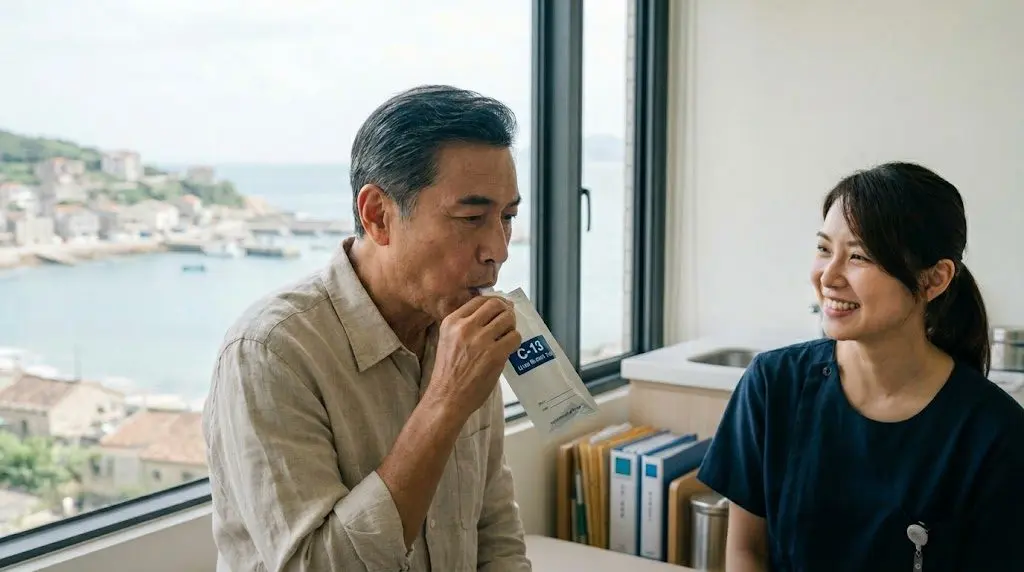
Matsu was historically a high-risk area for gastric cancer. To address this, the local health authorities did not ask everyone to get endoscopies. Instead, they implemented mass H. pylori screening using a method called the carbon-13 urea breath test, a simple breath test that gives results quickly.
If infection was detected, patients received eradication therapy. Endoscopy was reserved for cases where it was truly necessary.
The results were striking. Through this "screen first, then treat" approach, H. pylori prevalence on Matsu dropped significantly, and gastric cancer incidence fell alongside it. This experience demonstrates that community-based bacterial screening genuinely helps prevent gastric cancer.
Other areas of Taiwan have also adopted fecal antigen testing and family-based screening to increase participation and accuracy.
Age 40: A Critical Turning Point
Many people ask: "So when exactly should I get an endoscopy?"
Research indicates that if you have uninvestigated dyspepsia, age 40 is the critical cutoff.
Although we often assume young people are healthy, gastric cancer in younger patients is not rare in Taiwan. To avoid missing early-stage disease, medical experts recommend that the optimal age threshold for endoscopic evaluation of men and women with dyspepsia symptoms is 40. If you're 40 or older and frequently experience stomach discomfort, bloating, or pain, these symptoms can no longer be dismissed as ordinary stomach trouble. You should undergo endoscopy to rule out risk.
This recommendation ensures that no opportunity for early detection is missed. For those over 40, the probability of a serious condition lurking behind symptoms is significantly higher than in younger individuals, making an invasive endoscopic examination diagnostically worthwhile.
Do I Need Further Action?
When you receive a health screening report or feel unwell, here's how to determine your next step:
- No symptoms, under 40: Prioritize H. pylori testing (breath or stool test). For young adults wanting a baseline understanding of their stomach health. If negative, maintain good lifestyle habits.
- No symptoms, 40 or older: Also recommended to check H. pylori status first. If there is a family history, discuss with your doctor whether to add an endoscopy. For middle-aged individuals concerned about long-term gastric cancer risk. Subsequent steps depend on H. pylori test results.
- Dyspepsia symptoms, 40 or older: Strongly recommended to schedule an upper endoscopy. For middle-aged individuals with chronic stomach pain, bloating, or poor appetite. Based on the findings, the physician will advise follow-up at six months or one year.
- Diagnosed gastric mucosal atrophy or intestinal metaplasia: This places you in the high-risk category, and regular surveillance endoscopy is essential. For those previously told by a doctor that their stomach lining has changed. Strictly follow medical advice, typically every 1 to 3 years.
Are There Side Effects or Risks?
Every test and treatment has its considerations, and we need to be straightforward.
For H. pylori screening, methods such as the carbon-13 urea breath test and fecal antigen test are non-invasive, essentially free of side effects, and painless. This is precisely why mass screening programs like the Matsu experience use these methods first: public acceptance is high and risk is extremely low.
As for endoscopy, it is indeed the gold standard for diagnosis, particularly for high-risk individuals or those with alarm symptoms. However, it is an invasive procedure. Patients may experience throat discomfort and nausea, and in very rare cases, there is a risk of mucosal injury. Additionally, the quality of the endoscopy matters. If the endoscopist is inadequately trained or the examination is too rushed, small lesions may be missed.
This is why we don't recommend sending everyone for an endoscopy indiscriminately. Reserving this precise tool for individuals over 40 with symptoms, those who test positive for H. pylori, or those with known mucosal changes ensures that the benefits of the procedure outweigh its discomfort and risks.
What Does the Doctor Recommend?
Now that you've read through the explanation above, you should have a clearer sense of how to protect your stomach. Let's translate that knowledge into concrete action.
Take H. pylori Head-On
If you've never been tested for H. pylori, find the time to do it. This is a widely available test at medical facilities throughout Taiwan. If the result is positive, complete the eradication therapy as prescribed.
The "screen-and-treat" strategy has been proven to effectively reduce gastric cancer risk. Eliminating the bacterium is like ripping out the weeds by the roots, restoring a clean environment for your stomach lining.
Listen to Your Body's Warning Signals
For those who are 40 or older, please be more attuned to your body. If you've been experiencing chronic indigestion, bloating, or upper abdominal discomfort, don't just rely on antacids to suppress the symptoms. This age range is a "critical threshold" in the eyes of physicians. These symptoms may be your body reminding you that further investigation is needed.
At this point, scheduling a high-quality endoscopy is absolutely a worthwhile investment.
Long-Term Surveillance for High-Risk Changes
If previous testing has already revealed severe gastric mucosal atrophy or intestinal metaplasia, meaning the stomach lining has begun to resemble intestinal tissue, this indicates your stomach has endured long-term inflammation. In this situation, you belong to a high-risk group. Follow your doctor's recommendations and return regularly for surveillance endoscopy.
Through periodic check-ins, we can ensure everything stays under control and intervene immediately if anything changes.
Common Misconceptions Clarified
Myth 1: If we're afraid of gastric cancer, why not simply require everyone to get an endoscopy?
The truth: Taiwan's gastric cancer incidence is moderate, not nearly as high as in Japan or Korea. Universal endoscopy screening is extremely costly and provides limited benefit for the average low-risk individual. Current scientific evidence supports "screen for the bacterium first, then scope high-risk groups" as the smartest approach.
Myth 2: I'm only in my 30s. My stomachache must be from work stress. I'll tough it out.
The truth: While 40 is the recommended screening threshold, this doesn't mean young people are immune to stomach disease. Young-onset gastric cancer is not rare in Taiwan. If you have a family history, or if your symptoms are persistent, or if you have alarm signs such as unintentional weight loss or black stools, you should seek medical care immediately regardless of age. Don't let your age limit your judgment.
Myth 3: Once H. pylori has been eradicated, I never have to worry about it again, right?
The truth: Successful eradication does dramatically lower the risk, but reinfection from the environment is possible, or the stomach lining may have already developed irreversible changes like intestinal metaplasia before treatment. So if you belong to the group with pre-existing mucosal damage, regular endoscopic surveillance remains necessary even after eradication. Don't let your guard down.
Key Takeaways
Taiwan's gastric cancer prevention strategy prioritizes H. pylori screening and treatment. Eliminating the bacterium first reduces risk at its source.
Reaching age 40 with dyspepsia symptoms is the critical window for endoscopic evaluation. Do not ignore persistent digestive complaints.
Individuals with severe gastric mucosal atrophy or intestinal metaplasia are high-risk and must return regularly for endoscopic surveillance.