Abnormal Lung Function Test Results Don't Always Mean Disease: 3 Key Indicators for Airflow Obstruction and How Aging Naturally Affects Your Numbers
When you see the word "obstruction" on your lung function report, don't panic. The medical community has found that many older adults whose values fall below a single cutoff are simply experiencing the natural effects of aging — not actual disease. The key to determining whether your airways are truly blocked lies in the ratio of forced expiratory volume in one second (FEV1) to forced vital capacity (FVC). With appropriate follow-up testing as directed by your doctor, you can accurately identify real respiratory problems and avoid unnecessary alarm.
Chun-Mei is sixty-seven years old. Before retirement, she ran a flower shop for twenty years. Now her greatest joy is singing karaoke every Wednesday afternoon with her girlfriends at the community center. Her signature song is Teresa Teng's "The Moon Represents My Heart," and she always nails the chorus with power and poise.
But in recent months, she's noticed that she chokes on the high notes — as if the air just won't come. Pushing through to finish the whole song leaves her winded. Her friends tease her: "Chun-Mei, have you been slacking on practice?" She laughs it off, but privately she's worried — because it's not just singing. Even climbing from the first floor to the third-floor community center, she has to stop on the second-floor landing to catch her breath.
Her son arranged a health checkup. Most of the results came back normal, but the pulmonary function section was flagged: "FEV1/FVC ratio low; suggestive of obstructive pattern."
Chun-Mei couldn't make much sense of the English abbreviations, but she recognized the word "obstruction." Anxiously, she asked her son: "Are my lungs ruined? Am I going to need oxygen?"
In fact, this red flag doesn't necessarily mean her lungs are diseased. Machine-generated standards often use a one-size-fits-all cutoff that doesn't account for the natural decline in lung elasticity and capacity that comes with aging. What we need to do is determine whether this is simply aging or a genuine airway problem.
Why the Report Shows a Red Flag
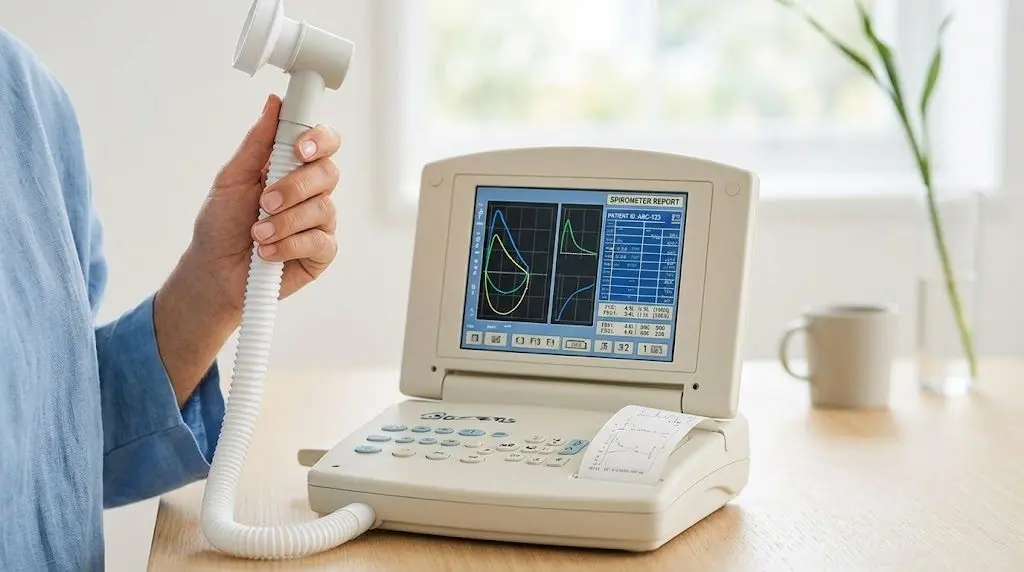
The two most commonly examined indicators in pulmonary function testing are forced vital capacity (FVC), which represents the total volume of air you can exhale after taking the deepest possible breath, and forced expiratory volume in one second (FEV1), which is how much air you can push out in the first second of exhalation. Dividing these two numbers gives you the ratio that determines whether obstruction is present.
A Pipe Clogged with Grime vs. Water Flow Speed
Imagine a garden hose. If the inside is clean and clear, the moment you turn on the tap, water gushes out in large volume right away in that first second. That's like healthy airways — the first-second expiratory volume makes up a large proportion of the total.
When the hose is clogged with algae or sediment, the bore narrows. Even at full pressure, water can only trickle out, and the volume in the first second drops dramatically. When airways are inflamed or blocked by mucus, air can't exit smoothly, the ratio drops, and the machine labels it as obstruction.
Elastic Bands Losing Their Stretch
We can also imagine the lungs as a highly elastic balloon wrapped in countless rubber bands. When you're young, those rubber bands are taut. Inflate the balloon and let go, and the air rushes right out. That's why young people typically have excellent first-second expiratory volumes — the lungs' recoil force is powerful.
As decades pass, those rubber bands lose their original elasticity after years of use. Even with the same amount of air inside the balloon, it empties more slowly. This is a natural structural change in the body, which is why standards for older adults should differ from those for younger people. Using the same benchmark for everyone only causes unnecessary alarm.
What Does the Research Say?
The medical community has long debated how to define "airflow obstruction." Currently, there are two main international standards, each with different considerations and target populations.
The Precision Approach from International Societies
The American Thoracic Society and the European Respiratory Society recommend using the "lower limit of normal" (LLN) as the threshold. They collected data from a large population of healthy individuals and identified the fifth-percentile cutoff as the boundary for abnormality. The advantage of this approach is that it accounts for age-related decline, effectively reducing misdiagnosis.
For young people with highly elastic lungs, applying a fixed number could miss early pathology. Conversely, applying the same strict cutoff to elderly individuals would label a large number of healthy seniors as diseased. Using a floating lower limit of normal makes the diagnosis much more reflective of actual physical condition.
The Simple, Fixed Threshold
The Global Initiative for Chronic Obstructive Lung Disease (GOLD) uses a fixed number for frontline clinical convenience. If, after inhaling a bronchodilator, the FEV1/FVC ratio is below 0.70, the patient is classified as having airflow obstruction.
This approach is simple and easy to remember, providing a universal language for clinicians worldwide. GOLD itself acknowledges the standard's limitations: it may lead to over-diagnosis in older populations and under-diagnosis in younger ones. This discrepancy isn't coincidental. Large studies have confirmed that age significantly affects the accuracy of the fixed threshold.
The Critical Test for Finding the True Cause
When the numbers come in low, the next step is assessing how severe the obstruction is, primarily by determining how much the FEV1 is reduced compared to normal. To distinguish between asthma and chronic inflammation, the patient inhales a bronchodilator and then repeats the test.
If the numbers improve significantly after the medication, it suggests the obstruction is reversible — typically pointing toward asthma. If the values are borderline, the doctor may further measure slow vital capacity or inspiratory capacity, using different angles to confirm the lungs' true functional status.
Hidden Dangers Behind Normal Numbers
Sometimes, even though the FEV1/FVC ratio looks perfectly normal, the patient still feels short of breath. This could mean the problem lies in the upper airways — for example, compression of the main trachea.
In these cases, peak expiratory flow rate usually drops noticeably, forming a stark contrast with the normal ratio. The doctor will then examine the flow-volume loop pattern to locate the deeply hidden problem.
Do I Need Further Action?
- Values hovering near the borderline: Maintain good lifestyle habits and practice deep breathing. For healthy adults with no symptoms. Follow up at the annual routine checkup.
- Values still below threshold after bronchodilator: Arrange a chest X-ray or CT scan. For those with a smoking history or chronic cough and shortness of breath. Follow up within three months as directed.
- Normal ratio but low peak flow: Proceed with flow-volume loop and upper airway evaluation. For those who hear noises when breathing or have difficulty swallowing. Schedule an ENT or pulmonology evaluation promptly.
Are There Side Effects or Risks?
Pulmonary function testing itself is very safe. There are no needles, no blood draws, and no radiation whatsoever. The main challenge is that the test heavily depends on patient cooperation. If your blowing technique is off, or your lips don't seal tightly around the mouthpiece, the numbers will be unreliable. Many people, worried about air leaking or not exhaling with full force, end up with a false positive for obstruction.
During the test, you'll need to breathe forcefully and repeatedly. Some older adults may feel lightheaded or experience mild chest tightness. It's like sudden vigorous exercise — just rest for a few minutes and the discomfort passes quickly. If you have a history of heart disease or have recently had eye surgery, be sure to inform the technician beforehand.
As for the bronchodilator used in reversibility testing, a very small number of people may experience hand tremors or a slightly faster heartbeat after inhalation. This is a natural response from the drug acting on the sympathetic nervous system and typically fades within an hour or two. The dose is very low, the burden on the body is minimal, and there's no need for excessive concern.
What Does the Doctor Recommend?
The red flag on the report is just a prompt. What truly determines your future health is your daily routine. With early detection and lifestyle adjustments, many mild respiratory symptoms can improve significantly.
Treat Your Lungs Like a Filter That Needs Maintenance
Quitting smoking is the single most important thing you can do for your lungs, including avoiding secondhand and thirdhand smoke. The tar and chemicals in cigarettes keep the airways chronically inflamed — it's like splashing dirty water on your air purifier's filter every day. On days with poor air quality, wearing a mask helps your lungs block out a significant amount of particulate matter.
Your home environment needs regular cleaning too, especially bedding and curtains where dust and dust mites accumulate. Always turn on the range hood when cooking to minimize oil fume inhalation. Give your lungs a clean breathing environment, and they'll function much more smoothly.
Eat Right to Support Airway Health
Include foods rich in vitamins C and E — guava, kiwi, and nuts, for example. These nutrients fight inflammation and protect airway mucosal cells. Adequate hydration is also important. Drinking enough water daily thins respiratory secretions, making mucus easier to cough up.
Minimize ultra-processed foods and sugary drinks, which tend to promote inflammatory responses in the body. Eating simply and naturally is the best protective shield for your body.
Ten Minutes of Breathing Practice Daily
Exercise is the most direct way to build lung capacity. You don't need to start with running or swimming right away. A twenty-minute brisk walk in the park each evening, at a pace where you're slightly breathless but can still carry on a conversation, effectively trains the respiratory muscles.
At home, you can practice pursed-lip breathing: inhale deeply through the nose, then purse your lips as if blowing out a candle and exhale slowly. This simple technique helps keep the airways open and facilitates the expulsion of stale air trapped deep in the lungs.
Common Misconceptions
The report says airflow obstruction. Does that mean I have lung cancer?
The truth: Pulmonary function tests only measure how smoothly air moves in and out of the lungs. They absolutely cannot diagnose lung cancer. Airflow obstruction is typically caused by asthma, chronic bronchitis, or simple aging. To check for lung tumors, you need a chest X-ray or low-dose CT scan.
Inhaled medications are addictive. I should avoid them if possible, right?
The truth: If your doctor determines you need a bronchodilator, please use it as prescribed. These inhaled medications act very locally, staying primarily in the airways with minimal amounts entering the bloodstream. They directly soothe inflamed airways, do not cause dependence, and actually prevent permanent scarring from repeated inflammation.
I breathe just fine in daily life. The abnormal number must be a machine error, right?
The truth: The lungs are remarkably tolerant organs with strong compensatory capacity. By the time you start feeling short of breath, you've usually already lost a substantial portion of lung function. The purpose of screening is to catch those subtle changes before you feel anything, buying you time for prevention.
Key Takeaways
Understand what the indicators mean: The most important measure for airway obstruction is the ratio of first-second expiratory volume to total vital capacity. A low value indicates air is having difficulty getting out.
Age affects the assessment: International authorities recommend incorporating age into the evaluation. Standards for older adults are inherently different from those for younger people, and a mildly out-of-range value doesn't necessarily indicate disease.
Follow through with advanced testing: If abnormalities appear, cooperating with bronchodilator reversibility testing or advanced imaging helps your doctor pinpoint the problem's source with precision.
If you still have questions about the numbers on your report, bring it to a family medicine or pulmonology appointment and have a conversation with your doctor.